
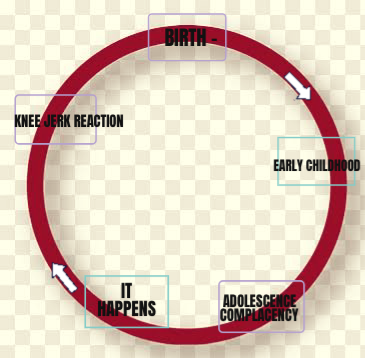
So, Phil, how does this life cycle operate? Well, let’s start with ‘Day One’ which for arguments sake is the safety birthday and can actually be the first day on the job, first day of operation or first day of the year. The cycle begins here!
(BIRTH – LIFE CYCLE BEGINS) After being hired, you complete orientation, forklift training, certification, and then assigned to begin working in the warehouse moving pallets to and from the dock. One of the main rules of the road is to use your forklift horn when coming to corners and blind spots or before backing up. The first few days of your lifecycle you’re observed by your supervisor to ensure you are doing all the right things in safety, proper parking of forklift and accuracy in putting product away. You will not hear another mention of safety until next months safety meeting. Everything on the floor seems to be moving and flowing perfectly, and there may have been a close call between pedestrians and a forklift, nothing serious, not even worth mentioning to management.
( EARLY CHILDHOOD) It finally arrives, your first monthly company safety meeting being held in the conference room. This month’s company safety topic is, ‘Wear your PPE, safety glasses/goggles! In fact the company prides itself on covering a variety of topics throughout the year, unfortunately it’s the same topic, for each month, for each year. Last February was PPE, safety glasses/goggles and not by coincidence but by design, this February is PPE, safety glasses/goggles. This ordinarily wouldn’t be a problem except for the fact there have been more close calls and a one reported near miss with a pedestrian and a forklift in the warehouse and this would have been a great time for a refresher.
- Be flexible with monthly safety meeting topics and make them interesting by having employees doing the demonstrations. Don’t wait for a monthly meeting to address an issue. Use morning huddles or tailgate meetings for reminders. You can taylor them to your specific needs, not the companies need for simple compliance. Create safety enthusiast.

(COMPLACENCY – ADOLESCENCE) Complacency is the greatest antagonist for any organization, and the greatest challenge is combating it. During the initial training and probation period, employees are on their best behavior. Then over time, they’ve been observing the long term employees, and to either fit in with the group or by peer pressure they mimic their actions. They also notice which supervisors are more lenient on mistakes and who is less tolerant of safety infractions. Then on a very busy work day, their concentration slips a little, while thinking of personal finance issues, family and so on instead of focusing and you soon, forget a honk.
- It’s up to the supervisor who should know his staff better than anyone, when to step in and coach a driver.
Currently, the top priority for the supervisors and managers is focus on production and shipping complete orders out the door as the last quarter is about to begin. Supervisors can become distracted, as they meet loading schedules, production schedules, inventory checks, check the sick line, schedule overtime, verify time cards, approve PT and trouble shoot bottlenecks or breakdowns, they may not decide to coach a driver at that moment of infraction, but has every intention to mention it later. But as we all know the unexpected always pops up as distractions on the floor increase, and you ironically find yourself pushing the forklift drivers to move loads a little quicker, which increases the chances they begin to cut corners and forget to honk and look back before reversing, because the last 100 times I looked no one was there and my neck hurts from all the turning. It’s natural to get a false sense of security when everything is running smoothly but then, complacency takes a firm hold, leading to more pressure on everyone which builds assisted by the peak season reaching a crescendo. Complacency aids outsider to use equipmentzzz
(IT HAPPENS.) It could be any day of the week. A bright sunny day or a windy chilly autumn afternoon, accidents have no set time or agenda as they are not planned but they do love to pop up at the most inconvenient time. They’re accidents. They seem to come out of thin air with no warning, but we know there were warnings. Little signs that went unnoticed, and now a serious accident has occurred between two forklifts, but the twist is an outside contractor decided to hop on a forklift that was not properly parked, and while the driver was using the restroom because the contractor’s time was more important than waiting for assistance from employees as he was told, to handle his tools and materials for the installation on part of a section of a new production line so he justified it to himself to use it without permission or training.
Now we are dealing with a seriously injured individual. We can hear his pain as our emergency response team waits with him for the ambulance. We heard a few hours later he had a broken arm, 2 fractured ribs, broken ankle and a good sized gash on his forehead. The other driver, our employee, is just shaken up. He had his seatbelt buckled and stayed within the cage when he was hit. The company brain trust is panicked. How long will the investigation delay our new line and will we be shut down? What will this cost us? What else will the investigators see? Panic builds. The questions flow from top to bottom, who gave that contractor permission and the answers flow bottom to top, NO ONE!
(THE KNEE JERK REACTION) – Is the panic reaction by upper management to any severe accident, without a careful thought out approach to a solution for an immediate problem, that you haven’t even bothered to fully investigated yet, so no clue your solutions are actually addressing the issue. Don’t waste time on an immediate investigation until we’re sure we’re can say, we’re not at fault because they want to first tell the world, it’s under control, we’re fixing it, what it is ain’t exactly clear, their thoughts are with the families of the victims, and my favorite, we always take workers safety seriously. The long term employees understand it’s nothing more than a dog and pony show. It’ll be the center of attention for awhile and then fade into the background like it has before, no real fix and that is the problem, they’re fixing nothing. If your rush to enacting new rules, without a proper training presentation, or clear direction in written instructions, it ends up with more confusion. I’ve seen it happen. Wasting more time on dealing with rumors and misrepresentations of actual facts. Putting out a new edict to the supervisors, that ONLY certified company staff can operate forklifts, without explaining to them how to enforce it, without physically getting in an outsider’s face, causes confusion!

To make matters worse, HR did not have complete records of everyone’s forklift training and certification. One of those oversights that occasionally happens when people are pushed through certification, under the excuse, we’re short handed, along with a manager forging test results for individuals he liked. So the panic that an investigation would expose all this, spread across the executive suites. They’re solution! Beginning with graveyard shift, next day, each shift supervisor had to complete an instant immediate recertification for those employees to validate the non-certification marathon BUT to make it look like an usual general refresher/recertification/safety program we had to re-certify every forklift driver on our shift. A complete waste of time, lost work hours and a big hit on productivity, but it’s not about how you feel, but how you look!
After the crazy day of re-certification, everyone was back on their best behavior, a little somber but fully honking and turning. The company really listened to the supervisors this time as we gave lots of imput on what we needed to keep a safe workplace. The new procedures were implemented, all companies that did business with us were notified of these new procedures with a list of penalties for violating those procedures. Giving control of the warehouse dock area back to the workers and keeping visitors at a safe distance. Will the cycle continue?
What do you do to address complacency at work? I believe continued consistent discussion helps a great deal. We’ll discuss that at a future date.
Next issue – does the cycle work the same in a much larger laboratory?
Permission to reprint must be obtained directly from the author or designated copyright owner.




Leave a comment